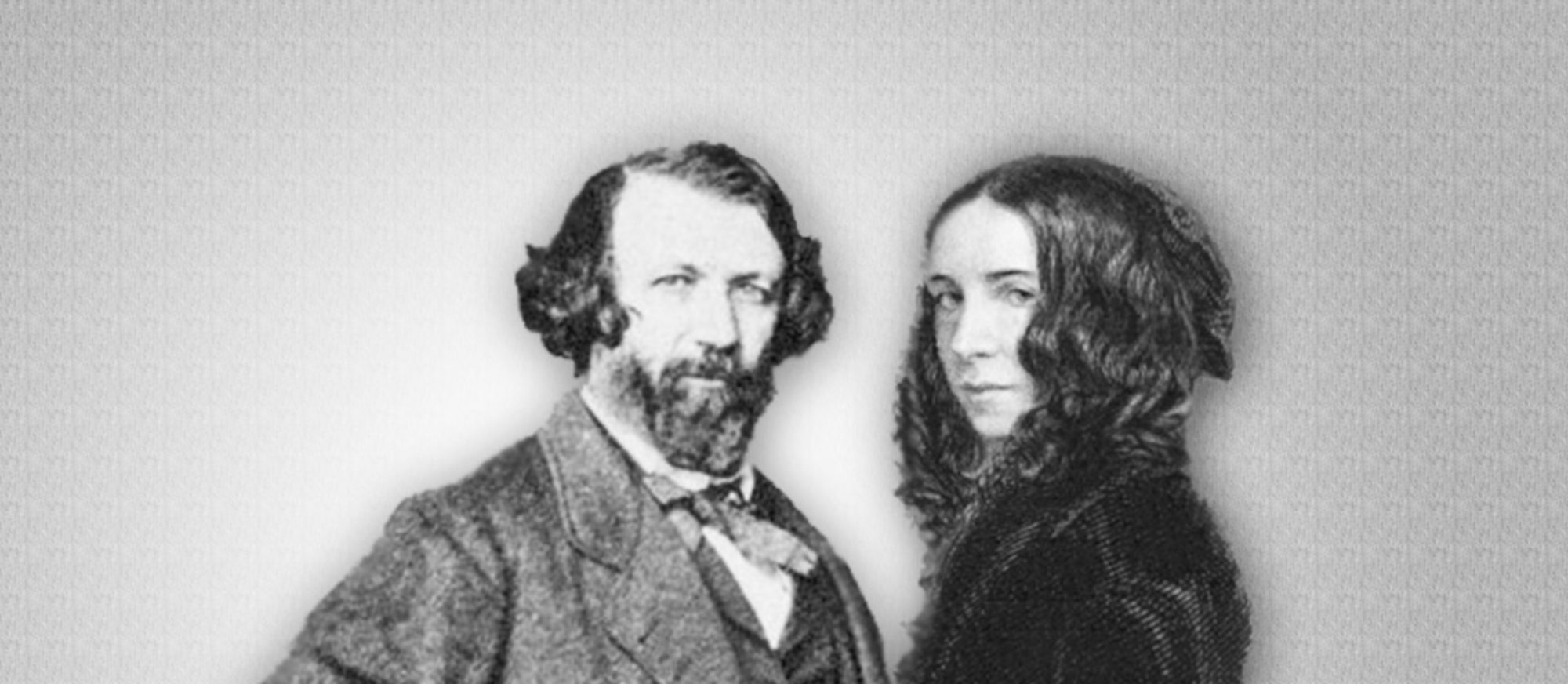
[Postmark: August 15, 1846]
Saturday Morning.
A bright beautiful day this is, on which you do not come
— it seems as if you ought to have come on it by rights.
Dearest, you did not meet Mr. Kenyon yesterday after you
left me ? I fancied that you might, and so be detected in
the three hours, to the fullest length of them — it seemed
possible. Now I look forward to the driving instead of to
you — and he has just sent to desire me to be ready at a
quarter to three, and not later, as was fixed in your
hearing. And why, pray, should you be glad that I am going
on this excursion ? I should have liked it, if we had been
living in the daylight ; but with all these ‘ shadows, clouds
and darkness, ‘ it is pleasanter to me to sit still and see
nobody — and least, Mr. Kenyon. Oh, that somebody
would spirit him away gently, very gently, so as to do him
no manner of harm in achieving the good for me ! — for
both you and me. Did you say ‘ Do you pity me ‘ to me ?
I did not tell you yesterday that I have another new fear
. . an American lady who in her time has reviewed both
you and me, it seems, comes to see me . . is about to
come to see me . . armed with a letter of introduction
from Mr. Mathews — and in a week, I may expect her perhaps.
She is directed, too, towards Mr. Horne. Observe
the double chain thrown across the road at my feet — I am
entreated to show her attention and introduce her to my
friends . . things out of the question as I am situated.
Yet I have not boldness to say ‘ I will not see you.’ I
almost must see her, I do fear. Mr. Mathews ought to
have felt his way a little, before throwing such a weight on
me. He is delighted with your ‘ Bells and Pomegranates ‘
(to pass from his frailties to his merits) and the
review of them is sent to me, he says — only that I do not
receive it.
Dearest, when I told you yesterday, after speaking of
the many coloured theologies of the house, that it was hard
to answer for what I was, . . I meant that I felt unwilling,
for my own part, to put on any of the liveries of the sects.
The truth, as God sees it, must be something so different
from these opinions about truth — these systems which fit
different classes of men like their coats, and wear brown at
the elbows always ! I believe in what is divine and floats
at highest, in all these different theologies — and because the
really Divine draws together souls, and tends so to a unity,
I could pray anywhere and with all sorts of worshippers,
from the Sistine Chapel to Mr. Fox’s, those kneeling and
those standing. Wherever you go, in all religious societies,
there is a little to revolt, and a good deal to bear with —
but it is not otherwise in the world without ; and, within, you
are especially reminded that God has to be more patient
than yourself after all. Still you go quickest there, where
your sympathies are least ruffled and disturbed — and I like,
beyond comparison best, the simplicity of the dissenters . .
the unwritten prayer, . . the sacraments administered
quietly and without charlatanism ! and the principle of a
church, as they hold it, I hold it too, . . quite apart from
state-necessities . . pure from the law. Well — there is
enough to dissent from among the dissenters — the Formula
is rampant among them as among others — you hear things
like the buzzing of flies in proof of a corruption — and see
every now and then something divine set up like a post for
men of irritable minds and passions to rub themselves
against, calling it a holy deed — you feel moreover bigotry
and ignorance pressing on you on all sides, till you gasp for
breath like one strangled. But better this, even, than
what is elsewhere — this being elsewhere too in different
degrees, besides the evil of the place. Public and social
prayer is right and desirable — and I would prefer, as a
matter of custom, to pray in one of those chapels, where
the minister is simple-minded and not controversial —
certainly would prefer it. Not exactly in the Socinian chapels,
nor yet in Mr. Fox’s — not by preference. The Unitarians
seem to me to throw over what is most beautiful in the
Christian Doctrine ; but the Formulists, on the other side,
stir up a dust, in which it appears excusable not to see.
When the veil of the body falls, how we shall look into
each other’s faces, astonished, . . after one glance at
God’s !
Have I written to you more than too much about my
doxy ? I was a little, little, uncomfortable in the retrospect
of yesterday, lest my quick answer should have struck you
as either a levity or an evasion — and have you not a right
to all ray thoughts of all things? For the rest, we will be
married just as you like . . volo quod vis : and you will
see by this profession of faith that I am not likely much to
care either way. There are some solemn and beautiful
things in the Church of England Marriage-service, as I once
heard it read, the only time I was present at such a ceremony
— but I heard it then in the abbreviated customary
form . . and not as the Puseyites (who always bring up the
old lamps against a new) choose to read it, they say, in spite
of custom. Archdeacon Hale with an inodorous old lamp,
displeased some of the congregation from Fenton’s Hotel, I
hear. But we need not go to the Puseyites at least. And
after all, perhaps the best will be what is easiest.
Something is sure to happen — something must surely happen
to put an end to it all … before I go to Greece !
May God bless you, ever dearest : Tell me if you get
this letter to-day, Saturday.
Your very own BA.